Learn / Lesson 6
How to write dual dialogue: two people talking at once
On the page, one speech follows another, so two people talking at once read like they took turns. Dual dialogue sets the two speeches side by side. Here is when to use it, how short to keep it, and the two cases that don’t need columns at all.
Chapters
- 0:00Two people, one moment
- 0:18One after the other
- 0:32Dual dialogue: side by side
- 0:50Keep it short
- 1:05Together, or overlapping
- 1:22Dual dialogue in Scenarist
- 1:43The whole page
Two people, one moment
People talk over each other all the time: two answers to one question, an argument, a startled “What?” A screenplay page has a way to show it, and two ways to show what’s close to it. This lesson uses all three in one short scene, Two Mugs. It picks up right after lesson 5, where Dev brought Ruth a chipped mug from the booth and hers was still on the counter. Now there are two.
One after the other
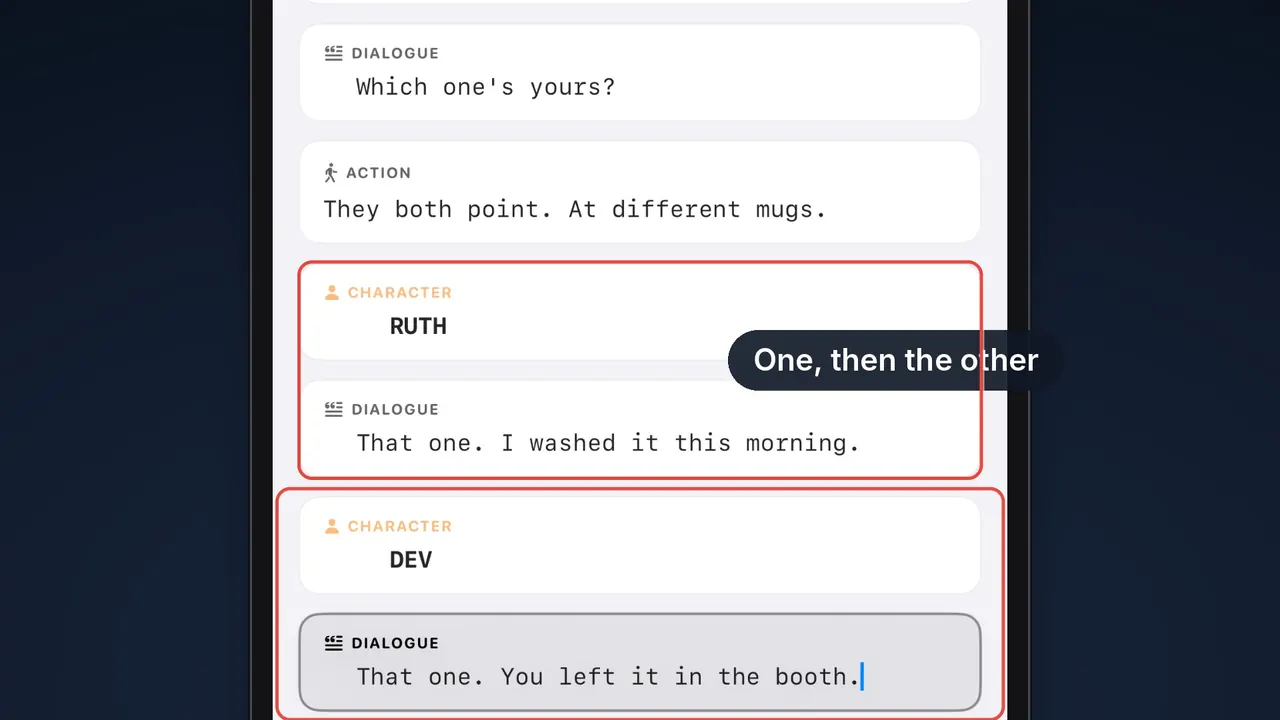
Dev asks which mug is hers, and they both answer. Written the usual way, it looks like this:
Two Mugs · Typed the usual way
DEV
Which one's yours?
They both point. At different mugs.
RUTH
That one. I washed it this morning.
DEV
That one. You left it in the booth.
A reader takes that as a conversation: Ruth says her line, and then Dev answers. But they say it at the same moment, and nothing on the page says so.
Dual dialogue: side by side
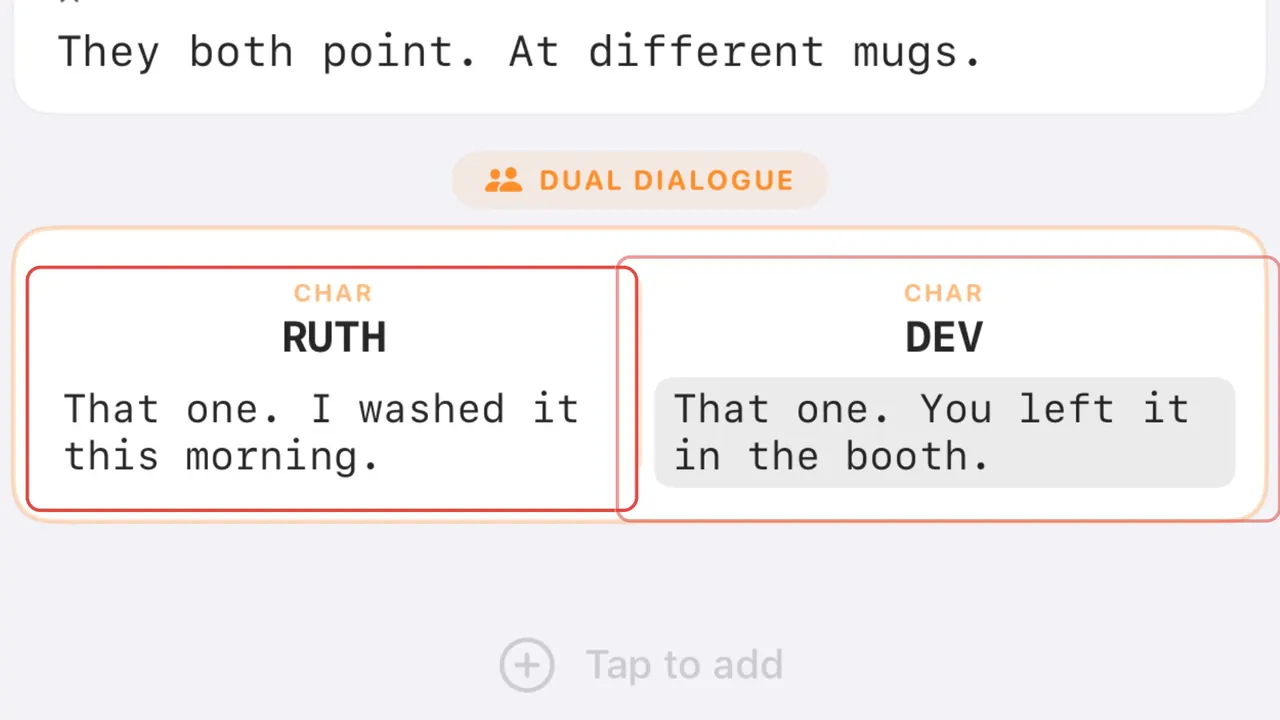
Dual dialogue puts the two speeches next to each other, in two columns, each name over its own line:
Two Mugs · Dual dialogue
RUTH
That one. I washed it this morning.
DEV
That one. You left it in the booth.
Now the reader takes the two in at a glance, as one moment: two people talking at once. Writers reach for it in comedy, and in scenes that should feel like real people talking, who do talk over each other. Final Draft’s own guide suggests it “for a comedic effect or to insert some naturalism.”
Keep it short
Keep both sides to a line or two. Each column is narrower than ordinary dialogue, so a long speech turns into a tall, thin block, and a reader can’t follow two of those at once. The second pair in the scene is about as short as it gets:
Two Mugs · Off, or up
RUTH
Turn it off.
DEV
Turn it up.
And keep it for words said at the same time. If two people take turns, however fast, that’s ordinary dialogue, one speech after the other.
Together, or overlapping
Two cases look like dual dialogue but don’t need columns. When two people say the same words at once, give them one name, with (together) under it:
Two Mugs · The same word
RUTH AND DEV
(together)
What?
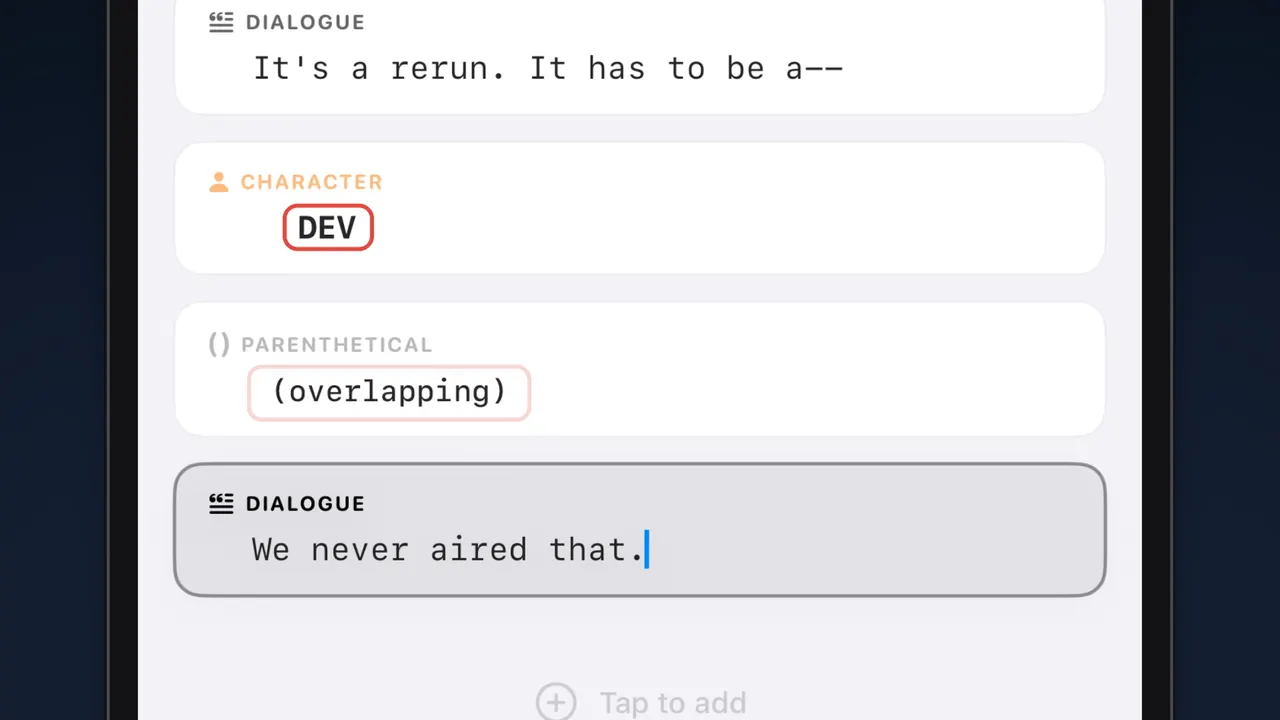
When one cuts in before the other finishes, keep one column: end the first line on a dash, and put (overlapping) under the second name.
Two Mugs · Cut off
RUTH
It's a rerun. It has to be a--
DEV
(overlapping)
We never aired that.
Dave Trottier sets both up the same way in his Dr. Format column: one shared name with (together), which you may not even need, and (overlapping) on the second speaker.
Dual dialogue in Scenarist
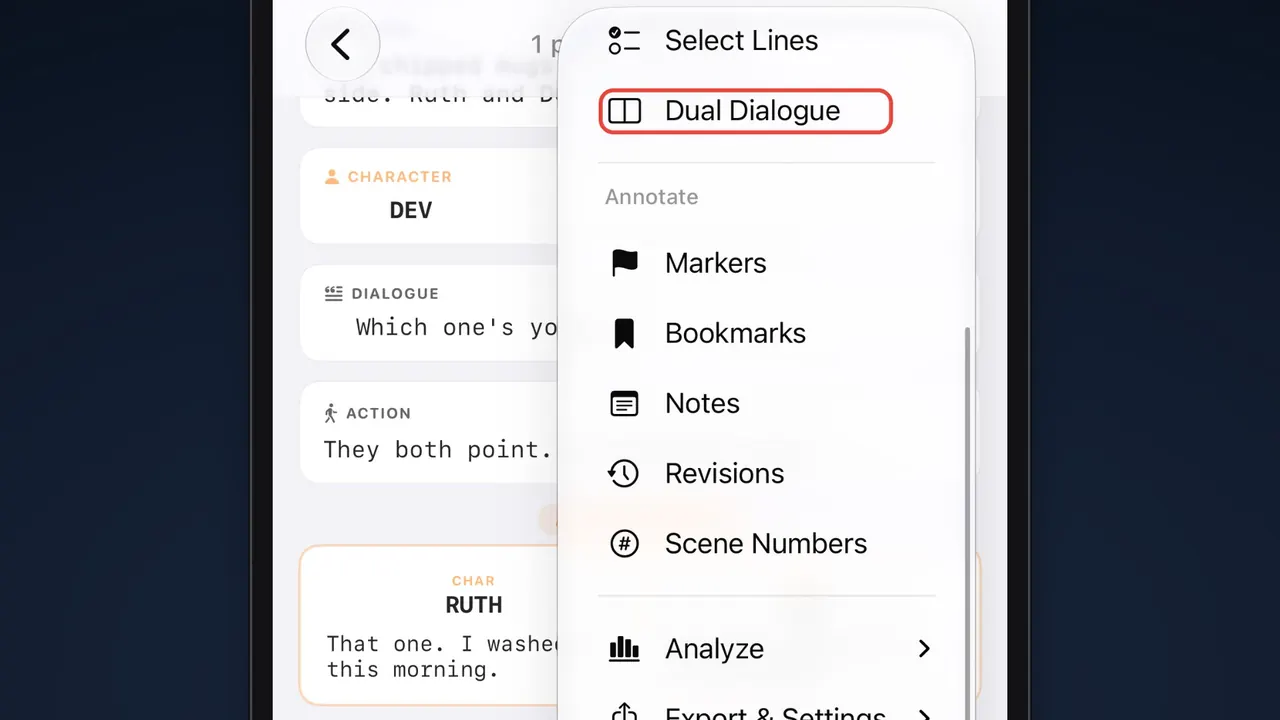
Open the ••• menu and choose Dual Dialogue: Scenarist adds a block with two columns after the line you’re on. Type the first name and its line; Return takes you to the second name, then to its line.
Already wrote the two speeches one after the other? Touch and hold the second name and choose Make Dual Dialogue. Touch and hold it again for Remove Dual Dialogue.
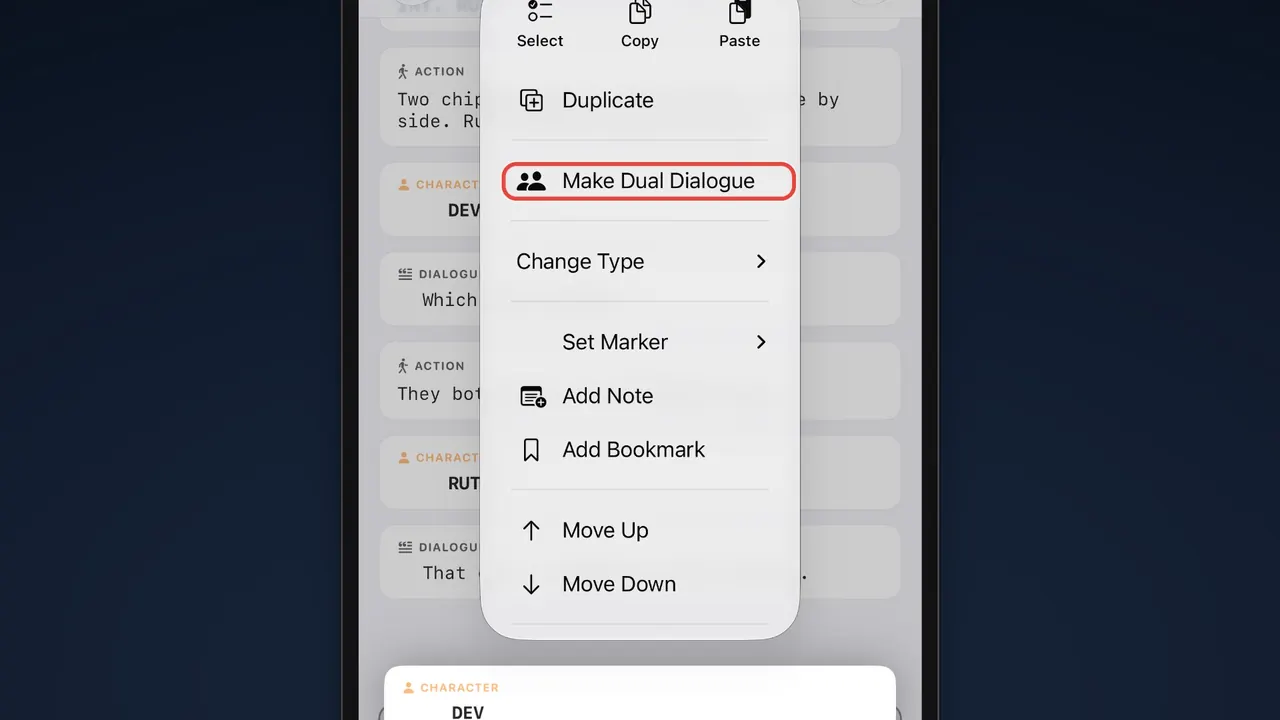
Dual dialogue prints side by side in Script Preview and the PDF, and it stays dual dialogue when you export to Final Draft (.fdx) or Fountain, where the second name ends in a caret (DEV ^).
The whole page
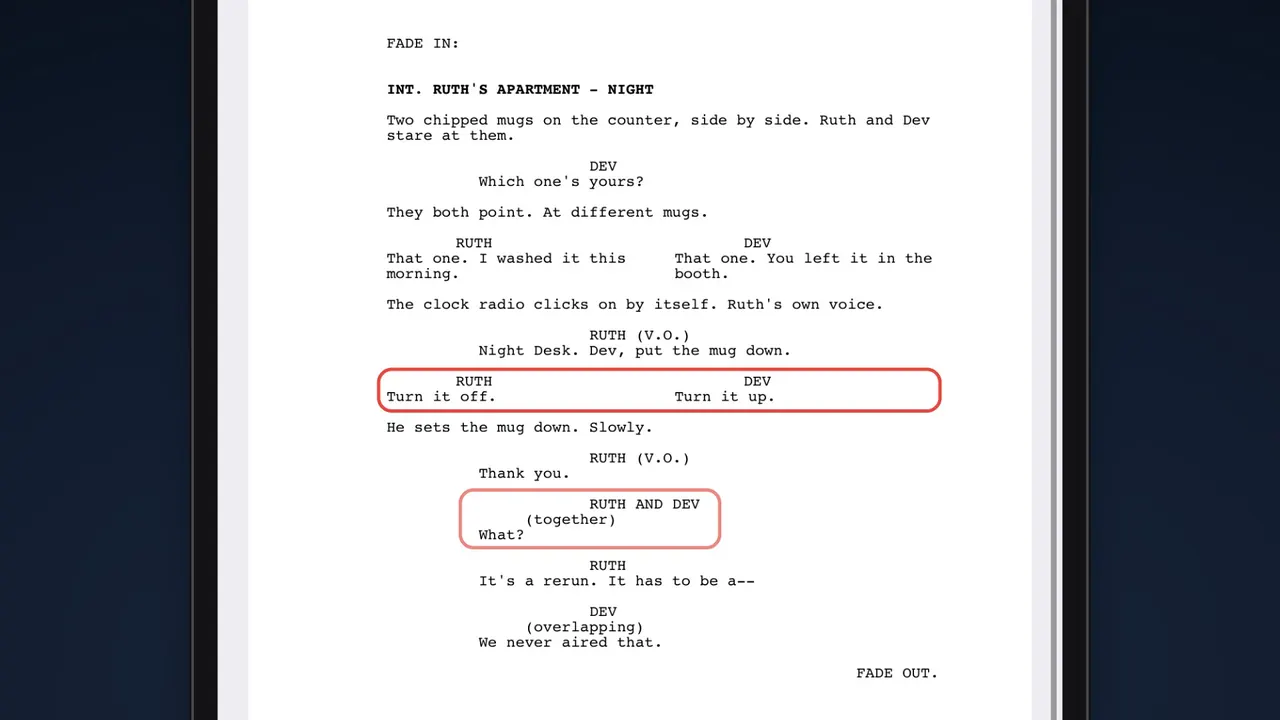
Here is the scene as it prints: two pairs side by side, one line said together and one cut off, in well under a page.
Two Mugs
FADE IN:
INT. RUTH'S APARTMENT - NIGHT
Two chipped mugs on the counter, side by side. Ruth and Dev stare at them.
DEV
Which one's yours?
They both point. At different mugs.
RUTH
That one. I washed it this morning.
DEV
That one. You left it in the booth.
The clock radio clicks on by itself. Ruth's own voice.
RUTH (V.O.)
Night Desk. Dev, put the mug down.
RUTH
Turn it off.
DEV
Turn it up.
He sets the mug down. Slowly.
RUTH (V.O.)
Thank you.
RUTH AND DEV
(together)
What?
RUTH
It's a rerun. It has to be a--
DEV
(overlapping)
We never aired that.
FADE OUT.
| When | On the page |
|---|---|
| Two people say different things at the same moment | Dual dialogue: two columns, a line or two each |
| Two people say the same words | One name for both, (together) |
| One cuts in before the other finishes | One column: a dash, then (overlapping) under the second name |
| They take turns | Ordinary dialogue, one speech after the other |
Next: export to Final Draft
The next lesson sends a script from an iPhone to Final Draft, as an .fdx file. New lessons go up first on YouTube.
Related guides
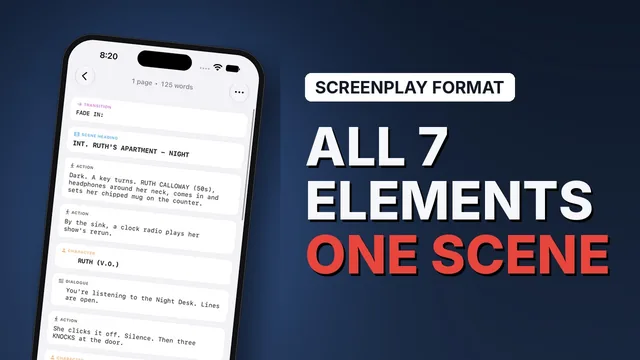
The seven screenplay elements
Scene heading through shot, as a short written guide.
What is Fountain?
The plain-text screenplay format, and why it lasts.
Best iPhone screenwriting apps in 2026
Every app you can actually write a draft on, compared on price, mobile support, and export.
Write your own scene
Scenarist sets dual dialogue side by side as you type, and keeps it that way in print, PDF, Final Draft and Fountain. On iPhone, iPad and Mac. Free to start, no account.
Get Scenarist