Learn / Lesson 5
Screenplay format explained: all seven elements in one scene
Every screenplay page is built from seven elements: scene heading, action, character, dialogue, parenthetical, shot and transition. Here is one scene that uses all seven, what each one is for and where it sits on the page, and the two you’ll almost never need.
Chapters
- 0:00Seven elements, one scene
- 0:171. Scene heading
- 0:362. Action
- 0:543–4. Character and dialogue
- 1:16O.S. and CONT’D
- 1:295. Shot
- 1:496. Parenthetical
- 2:037. Transition
- 2:21Formatting in Scenarist
- 2:43The whole page
Seven elements, one scene
Everything on a screenplay page is one of seven elements, and each one has a job and a place on the page. This lesson shows all seven in one scene. It picks up after lesson 3, where Ruth’s caller texted her from inside her own car. Now she’s home from the night shift, and someone knocks.
- Scene heading: where and when.
- Action: what we see and hear.
- Character: who speaks, and where the voice comes from.
- Dialogue: what they say.
- Shot: where the camera looks. Rarely.
- Parenthetical: how it’s said, when that isn’t obvious.
- Transition: how a scene ends. Rarely.
Under all seven is the same page: 12-point Courier, a 1.5-inch margin on the left and an inch on the other sides, about 55 lines. That’s why a page plays for about a minute, as lesson 4’s example script explains.
1. Scene heading
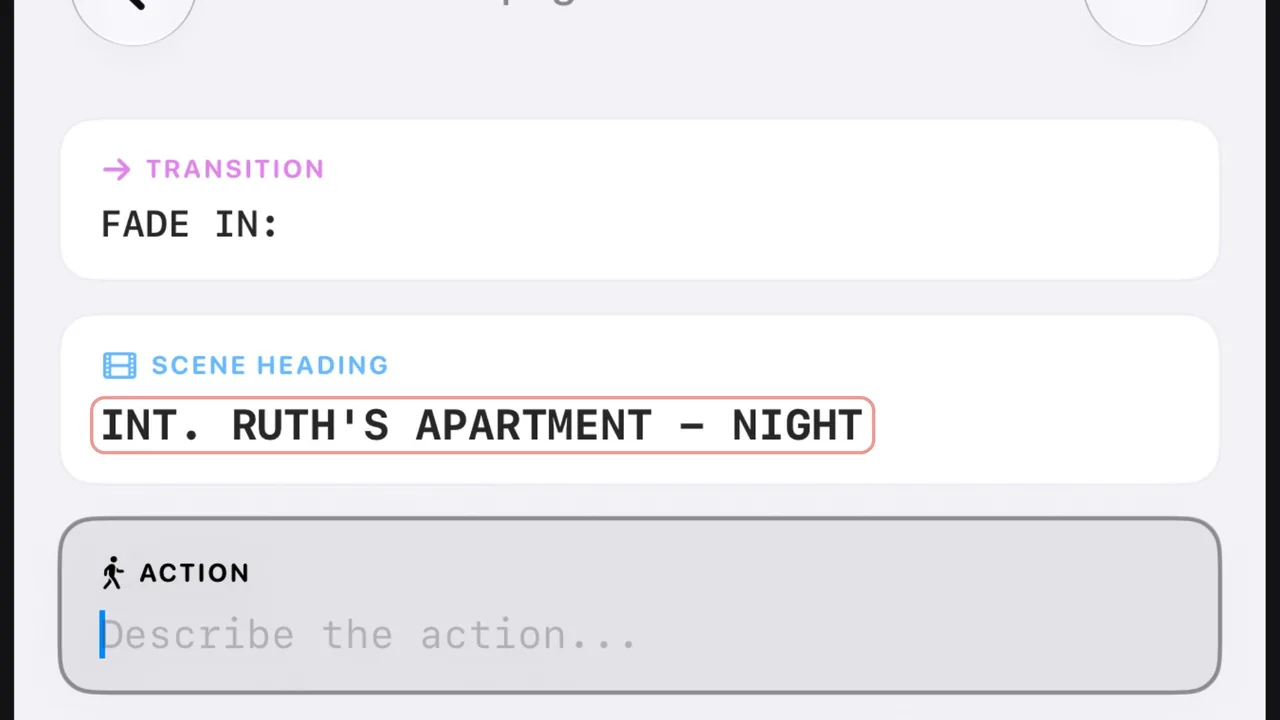
A script opens on FADE IN:, and every scene opens on a scene heading, also called a slugline: inside or outside, where, and when.
Knock · The scene heading
FADE IN:
INT. RUTH'S APARTMENT - NIGHT
It’s always in capitals: INT. for inside, EXT. for outside, then the place, then the time of day, usually DAY or NIGHT. Give a place the same name every time it comes back. The shoot is scheduled by those names, so RUTH'S APARTMENT and RUTH'S FLAT would be two locations to someone breaking the script down.
A few headings follow the same shape without a place: CONTINUOUS when the action runs straight on, LATER when time passes in the same place, and INSERT for a close look at a thing, like the phone in lesson 3.
2. Action
Under the heading, the action: what we see and hear, in the present tense, across the full width of the page.
Knock · Action
Dark. A key turns. RUTH CALLOWAY (50s), headphones around her neck, comes in and sets her chipped mug on the counter.
By the sink, a clock radio plays her show's rerun.
The first time a character appears, the name is in capitals, with an age: RUTH CALLOWAY (50s). After that, it’s just Ruth. A sound that matters can be in capitals too, like the KNOCKS further down. And keep paragraphs to three or four lines: white space is what keeps a page fast to read.
3. Character
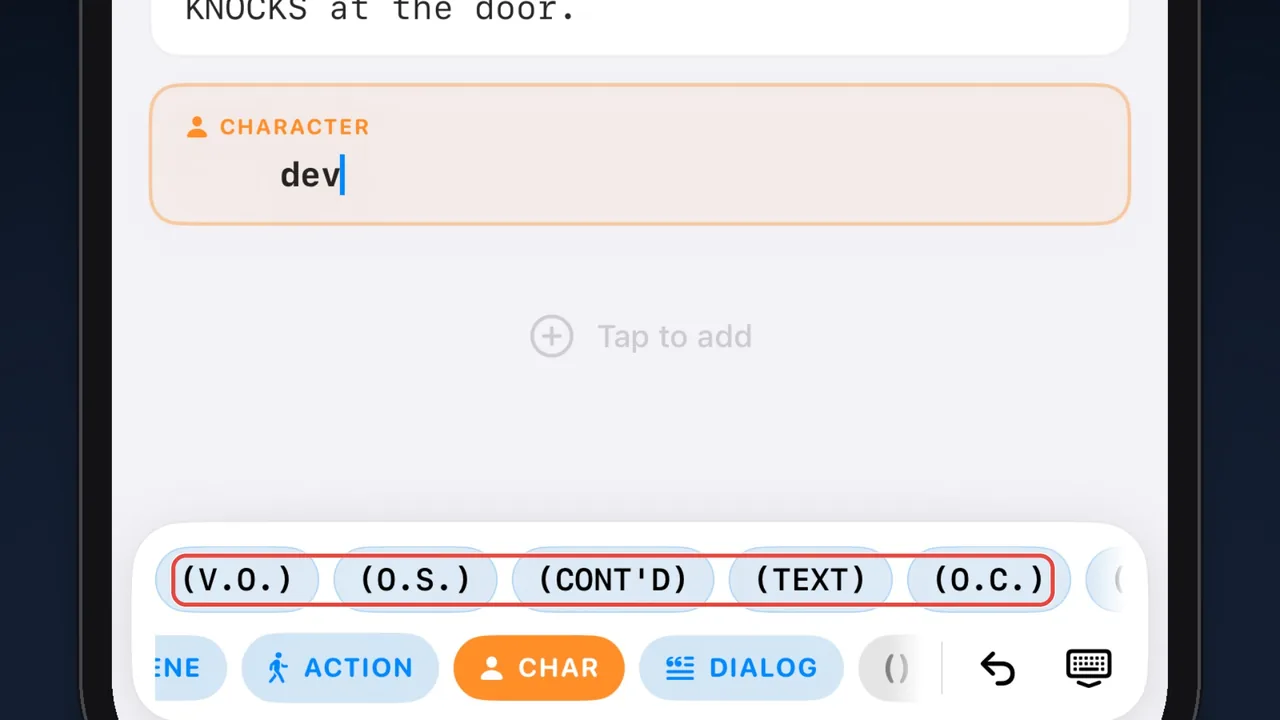
The character name, or cue, says who’s speaking: in capitals, indented toward the middle of the page, 3.7 inches from its left edge. After the name, an extension can say where the voice comes from.
Knock · Three extensions
RUTH (V.O.)
You're listening to the Night Desk. Lines are open.
She clicks it off. Silence. Then three KNOCKS at the door.
DEV (O.S.)
Ruth? It's Dev.
She opens it. DEV (30s), her producer, soaked from the rain, holds out a mug.
DEV
You left this in the booth.
Ruth doesn't take it.
DEV (CONT'D)
Ruth?
| Extension | When |
|---|---|
| (V.O.) voice-over | The voice comes from outside the scene: narration, a phone, a radio. Here, Ruth’s own show. |
| (O.S.) off screen | The speaker is there, in the scene, but out of shot: Dev behind the door. |
| (CONT'D) continued | The same character speaks again after a line of action. |
The radio is the one people get wrong: Ruth is in the room, but her voice on the radio isn’t coming from her, so it’s V.O. Script Magazine’s Dr. Format puts the rule in a line: off screen is physically there, voice-over comes from outside the scene. Lesson 2 works through the same choice for a phone call.
4. Dialogue
Under the name, the dialogue: what they say, in a narrower column that starts 2.5 inches from the left edge. That narrow column is part of why a page plays for about a minute. Write it the way people talk, contractions, fragments and all: “Ruth? It’s Dev.”
5. Shot
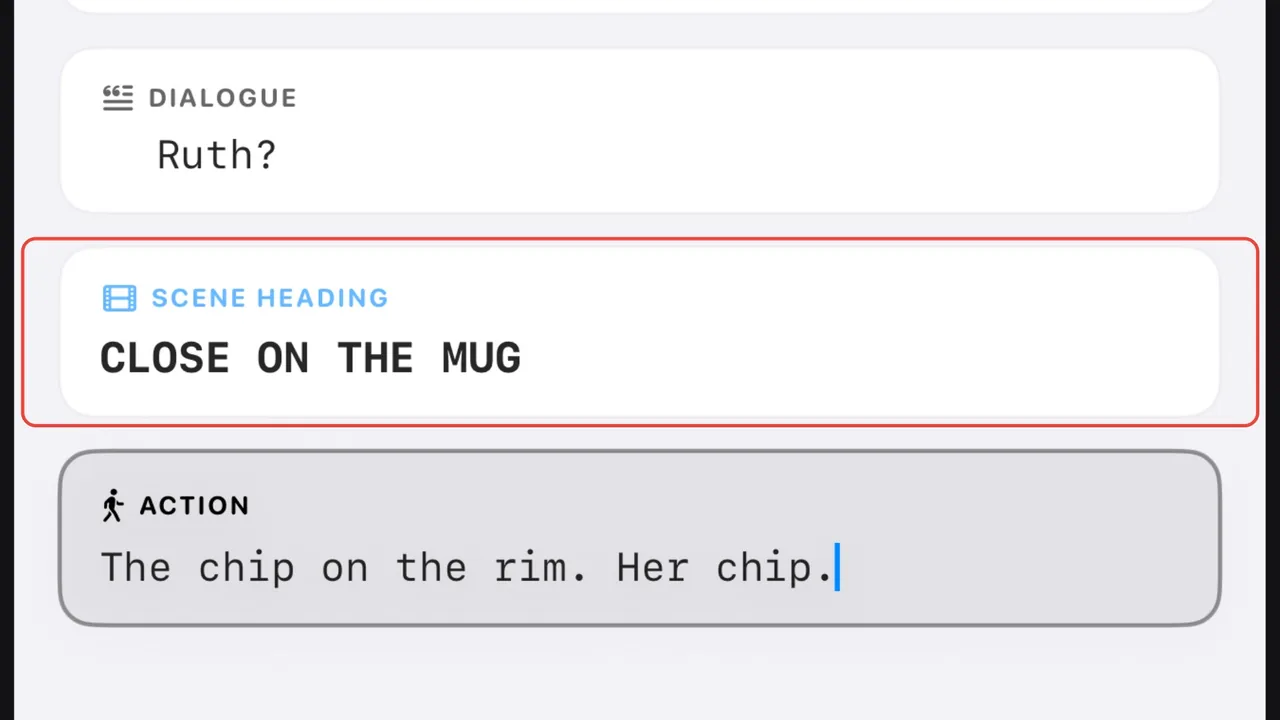
A shot tells the camera where to look: CLOSE ON, ANGLE ON, POV, INSERT. It sits at the left margin in capitals, like a heading.
Knock · The shot
CLOSE ON THE MUG
The chip on the rim. Her chip.
She looks back at the counter. Her mug is still there.
In a script you’re selling, the director chooses the shots, and camera directions read as stepping on that job, so most writers leave them out. Write one when the shot is the story. Here it is: the chip on Dev’s mug is the reveal.
6. Parenthetical
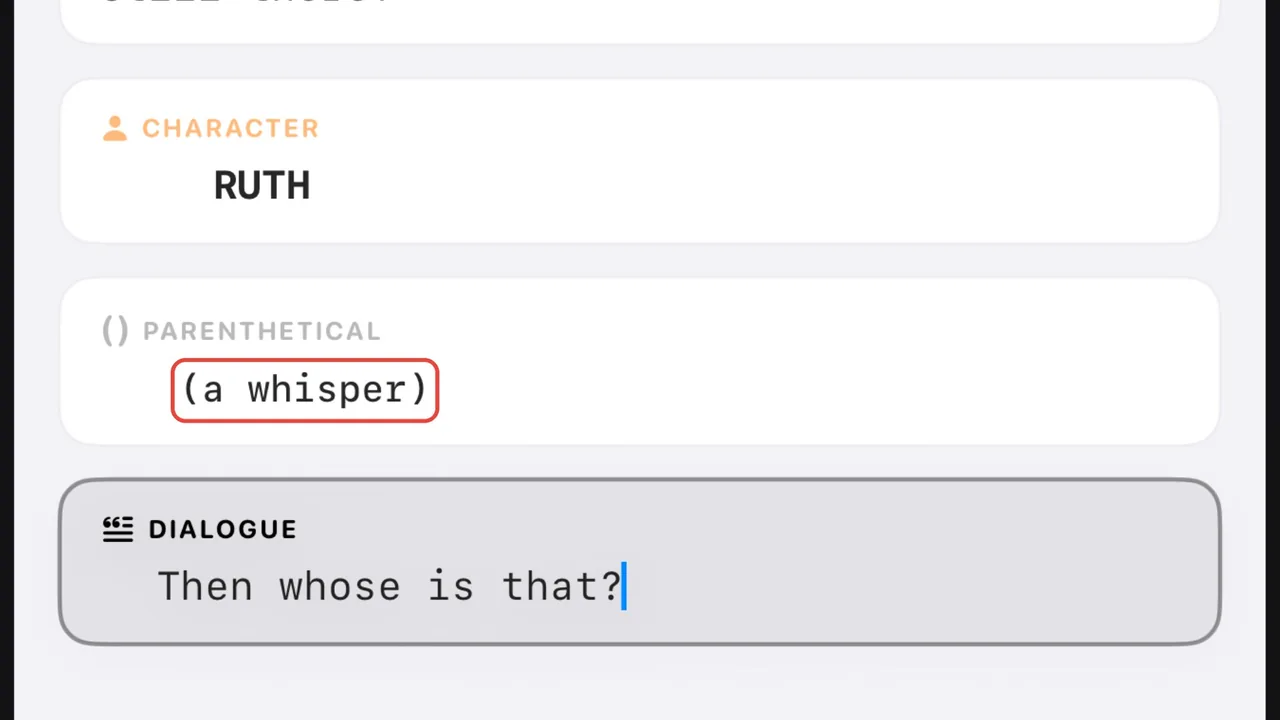
A parenthetical sits between the name and the line: a few words in lowercase, in brackets, about how it’s said.
Knock · A parenthetical
RUTH
(a whisper)
Then whose is that?
Use one only when the line could be read wrong. “Then whose is that?” could be shouted; here it’s barely said. If the line plays the same without the note, cut the note: the delivery is the actor’s job, and the director’s.
7. Transition
Transitions say how one scene becomes the next: CUT TO:, DISSOLVE TO:, SMASH CUT TO:, FADE OUT. They sit on the right, in capitals.
Knock · The last line
FADE OUT.
A new scene heading already means a cut, so CUT TO: between every scene only takes up lines. Keep transitions for the start and the end, FADE IN: and FADE OUT., and for a cut that’s part of the story.
The elements in Scenarist
In Scenarist, Return takes you to what usually comes next: after a scene heading, action; after action, a name; after a name, dialogue. Type in lowercase and it’s set in capitals when you press Return.
On a name, the keys above the keyboard offer the cast and (V.O.), (O.S.) and (CONT'D), with (CONT'D) first when the same character spoke last. There’s no separate shot element: type close on as a scene heading, and Scenarist accepts it without an INT. or EXT. The chips under the keys turn any line into another element.
The whole page
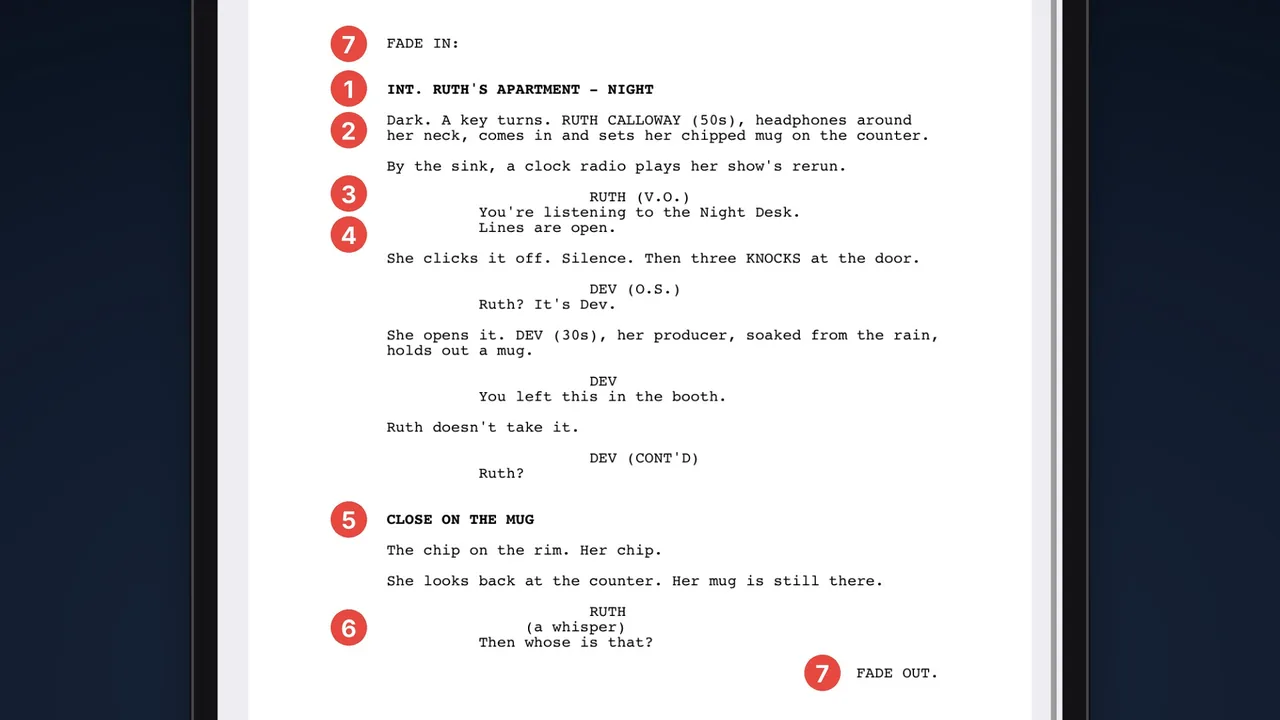
Here is the scene as it prints: seven elements on one page of Courier, about a minute of film.
Knock
FADE IN:
INT. RUTH'S APARTMENT - NIGHT
Dark. A key turns. RUTH CALLOWAY (50s), headphones around her neck, comes in and sets her chipped mug on the counter.
By the sink, a clock radio plays her show's rerun.
RUTH (V.O.)
You're listening to the Night Desk. Lines are open.
She clicks it off. Silence. Then three KNOCKS at the door.
DEV (O.S.)
Ruth? It's Dev.
She opens it. DEV (30s), her producer, soaked from the rain, holds out a mug.
DEV
You left this in the booth.
Ruth doesn't take it.
DEV (CONT'D)
Ruth?
CLOSE ON THE MUG
The chip on the rim. Her chip.
She looks back at the counter. Her mug is still there.
RUTH
(a whisper)
Then whose is that?
FADE OUT.
| Element | What it’s for | On the page |
|---|---|---|
| Scene heading | Where and when | Capitals, at the left margin |
| Action | What we see and hear | Full width, present tense |
| Character | Who speaks, and from where | Capitals, 3.7″ from the left edge |
| Dialogue | What they say | A narrow column, 2.5″ from the left |
| Shot | Where the camera looks. Rarely | Capitals, at the left margin |
| Parenthetical | How it’s said, when it isn’t obvious | In brackets, 3.1″ from the left |
| Transition | How a scene ends. Rarely | Capitals, on the right |
Next: dual dialogue
The next lesson is two people talking at once: dual dialogue, two columns side by side, and when the page needs it. New lessons go up first on YouTube.
Related guides
The seven screenplay elements
The same seven, as a short written guide.
What is Fountain?
The plain-text screenplay format, and why it lasts.
Screenplay revision colours, in order
How production tracks change across coloured pages.
Write your own scene
Scenarist sets every element as you type: headings and names in capitals, dialogue in its column, transitions on the right. On iPhone, iPad and Mac. Free to start, no account.
Get Scenarist